
Roasting & Grill Marking Technologies: Enhancing Flavor and Visual Appeal
Tunnel Roasting · Grill Marking · Full Pepper & Aubergine Lines | Gas-Fired Precision | From Vegetable Receiving to Can/Jar Filling
In the premium vegetable processing market, flavor and appearance are not afterthoughts — they are the product. A roasted pepper destined for a jarred antipasto, a char-marked aubergine slice going into a ready-to-eat tray, or a flame-roasted onion being peeled for further processing each carry a level of sensory quality that no seasoning or sauce can replicate after the fact. That quality is created in one place: at the roasting and grill marking stage.
For U.S. food processors competing in the growing premium grilled vegetable, ajvar, ready-to-eat meal, and specialty condiment markets, the engineering of the roasting stage — heat source, temperature control, conveyor design, throughput consistency — determines whether your finished product delivers the flavor depth and visual appeal that drives repeat purchase and commands premium shelf pricing.
At VegTech Systems, we supply and integrate Bigtem Makine’s roasting and grill marking equipment for U.S. processors — from standalone grill markers for sliced vegetables to fully automated, turnkey pepper and aubergine roasting and can/jar filling lines. Here is how these systems work and what they make possible for your operation.
The Science Behind the Flavor: Why Roasting Changes Everything
Roasting is not simply a cooking step — it is a controlled chemical transformation. Two processes drive the flavor and color development that make roasted vegetables commercially valuable:
The Maillard reaction occurs when amino acids and reducing sugars in the vegetable surface react under high heat, producing hundreds of complex flavor compounds — the characteristic deep, savory, slightly smoky notes associated with roasted peppers, aubergines, and courgettes. This reaction is highly temperature-dependent and begins in earnest above 150°C. Controlled, consistent heat exposure across the full product surface is what produces uniform Maillard development — and that is an engineering problem as much as a culinary one.
Caramelization of natural sugars adds sweetness, color depth, and the slightly bitter, complex top notes that distinguish a properly roasted vegetable from a merely cooked one. The combination of these two reactions produces the flavor profile that drives consumer preference and justifies the premium positioning of roasted vegetable products in U.S. retail.
Char and grill mark formation goes a step further — direct contact with a very high-temperature surface creates localized pyrolysis that produces the bitter, smoky char notes and the visually distinctive dark stripe pattern that consumers associate with authentic flame-grilling. This is the defining visual differentiator for grill-marked products.
Getting these reactions right, consistently, at production speed, across varying product sizes and moisture contents — that is exactly what Bigtem’s roasting and grill marking systems are engineered to deliver.
Heat Radiation Belt Type Tunnel Roaster
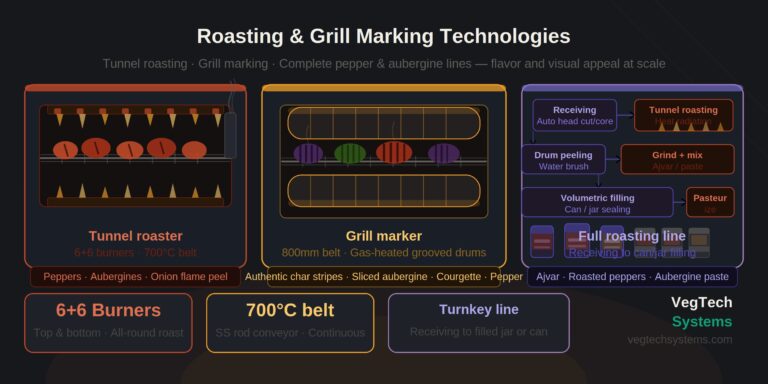
Bigtem’s Heat Radiation Belt Type Tunnel Roaster is the core of any high-capacity pepper, aubergine, or onion roasting operation. It is purpose-built for the continuous, high-throughput roasting that industrial processors require — and engineered around Bigtem’s own burner technology for precise, repeatable heat delivery.
How it works:
Product is conveyed continuously on a stainless steel rod belt rated to 700°C — a specification that reflects the extreme thermal environment these machines operate in. Bigtem’s specially designed burners position both above and below the conveyor, delivering heat radiation from both sides simultaneously for all-round roasting coverage with no cold zones.
A typical configuration runs 6 top burners and 6 bottom burners, supported by a high-capacity blower that supplies combustion air at precisely the right volume for each of 12 gas/air mixers. This gas/air mixing system is central to Bigtem’s efficiency advantage: by optimizing the fuel-to-air ratio at each burner independently, the system achieves maximum heat output at minimum gas consumption — directly reducing energy cost per ton of processed product.
A dedicated chimney system manages combustion gases and smoke, maintaining a safe and compliant operating environment within the production facility.
What it produces:
For peppers and aubergines, the tunnel roaster chars and blisters the skin evenly across the full surface of the product — which then proceeds to peeling (via Bigtem’s drum peeler), coring, and downstream filling or further processing. The roasting stage is what makes the skin separation in peeling possible, and the quality of the roast directly determines how cleanly the peel releases.
For onions, the tunnel roaster is used for flame peeling — a process where the dry outer layers are rapidly charred and blown or brushed away, revealing the clean, intact onion layers beneath. This is a high-throughput, low-labor alternative to mechanical peeling for certain onion processing applications.
Key performance drivers:
- Belt speed (controls dwell time and therefore roast intensity)
- Burner temperature and gas/air ratio (controls heat delivery)
- Product spacing and orientation on the rod belt (affects surface coverage)
- Product size uniformity (affects consistency across the batch)
All of these parameters are adjustable, allowing processors to calibrate the roasting profile to their specific product variety, size distribution, and target char level. VegTech Systems’ engineering team provides this calibration support as part of line commissioning for U.S. installations.
Grill Marker
Where the tunnel roaster produces full-surface roasting, the Bigtem Grill Marker delivers something more targeted and visually specific: the characteristic parallel stripe pattern that signals authenticity and premium quality in grill-marked vegetable products.
How it works:
Sliced vegetables — aubergine rounds, courgette slices, pepper halves, and similar products — are placed on an 800mm wide, 1600mm long stainless steel rod belt and conveyed between two gas burner-heated grooved drums. The drums, maintained at very high temperatures by direct gas burner heating, contact the product surface in a series of parallel lines that match the drum groove pattern. The brief, intense contact between the hot grooved drum surface and the vegetable slice creates the pyrolytic char reaction that produces authentic grill marks — dark, narrow stripes with the flavor and aroma profile of direct-fire grilling.
Product can be delivered to the belt via a laying conveyor or a vibrating feeder, depending on the product type and production line configuration. Both methods require attention to slice placement to prevent overlapping and to maximize use of the full grill marking surface — ensuring that each slice receives consistent, evenly spaced marks and that throughput capacity is fully utilized.
The visual value proposition:
Grill marks are a quality signal that consumers read immediately. In the U.S. retail ready-to-eat market, grill-marked vegetables command a significant premium over plain-cut or steam-cooked equivalents. They communicate craft, fire, and flavor before the package is even opened. For food service processors supplying QSR and casual dining operators, consistent grill mark appearance is often a contract specification — every slice must look the same, serve after serve.
The Bigtem Grill Marker delivers that consistency mechanically and continuously — replacing the throughput ceiling and labor cost of manual or batch grilling operations with a fully in-line, automated process.
Ideal applications for grill marking:
- Aubergine and courgette slices for antipasto and ready-to-eat trays
- Pepper halves for premium jarred and canned products
- Vegetable mix components for meal kit and food service supply
- Pre-grilled slices for retail fresh and frozen vegetable ranges
The Complete Pepper & Aubergine Roasting and Can/Jar Filling Line
For processors building or expanding a dedicated roasted vegetable operation, Bigtem’s full Pepper & Aubergine Roasting and Can/Jar Filling Line is a turnkey system that integrates every stage from raw product receiving through filled, sealed, and labeled cans or jars.
Bigtem developed this line specifically around the operational realities of pepper and aubergine processing — a product that presents unique challenges at each stage:
Automated head cutting and coring: Whole peppers must be topped and seeded before roasting or filling. Bigtem’s auto head cutter/corer handles this continuously, replacing a labor-intensive manual operation with consistent, high-throughput mechanical processing that is both faster and more dimensionally precise than hand-cutting.
Heat radiation roasting tunnels: New-generation tunnel roasters — engineered for minimum gas and water consumption without compromising roast quality — char the pepper or aubergine skin evenly and thoroughly to prepare it for peeling.
Water brush peeling: Following roasting, loosened skins are removed by water brush peelers designed for zero-labor operation. This integrates directly with the drum peeling stage and delivers consistently clean, peeled product for downstream filling.
Ajvar and aubergine paste production: For processors targeting the ajvar market — a roasted pepper and aubergine condiment with rapidly growing demand in U.S. specialty and ethnic food retail — Bigtem manufactures the full downstream equipment suite: hammer mills for grinding roasted product, pre-concentrating and evaporation systems for achieving the correct consistency, batch mixers, and volumetric fillers for precise filling into jars or cans.
Can and jar handling: Palletizers, depalletizers, gripper washers, and can/jar filling and sealing systems complete the line, delivering finished, filled, and sealed product directly to labeling and cold storage.
The result is a zero-labor-gap processing line from raw pepper or aubergine to sealed retail-ready jar — engineered in a single integrated system rather than assembled from mismatched components from multiple suppliers.
Market Applications: Where These Technologies Create Value
Roasting and grill marking are not commodity processing steps. They are value-creation operations that open specific, fast-growing premium market segments:
Jarred and canned roasted vegetables: One of the most consistent growth categories in U.S. specialty food retail. Roasted red peppers, grilled aubergine, and mixed antipasto products command 3–5× the retail price per kilogram of their raw equivalents. The roasting stage is what creates that value gap.
Ajvar and roasted pepper condiments: Ajvar — the roasted pepper and aubergine spread originating in the Balkans — is one of the fastest-growing specialty condiments in U.S. retail, driven by demand for bold, globally-inspired flavors. U.S. production of ajvar is still limited, representing a significant market opportunity for processors equipped with the right line.
Ready-to-eat grilled vegetable components: Food service distributors, meal kit companies, and retail fresh-prepared sections require grill-marked vegetables in volume. These are high-margin products that require consistent visual appearance across every unit — exactly what the Bigtem Grill Marker delivers.
Frozen grilled vegetables: The frozen premium vegetable segment continues to expand. Grill-marked or roasted vegetables frozen directly after processing retain their flavor and appearance characteristics through distribution — enabling processors to serve both fresh and frozen market channels from the same production line.
Onion flame peeling for downstream processing: For large-scale onion processing operations, tunnel-based flame peeling offers a high-throughput, low-labor alternative to mechanical abrasive peeling for certain applications, with favorable results on outer layer integrity.
Integration: Roasting Within a Complete Processing Line
At VegTech Systems, we engineer roasting and grill marking systems as integrated stages within complete turnkey lines — not as standalone machines that must be retrofitted into existing operations.
For a complete roasted pepper or aubergine line, the full process flow looks like this:
Receiving & washing → Size grading → Automated head cutting/coring → Heat radiation tunnel roasting → Drum peeling → Inspection → Coring/destemming → Filling → Sealing → Pasteurization → Labeling & packaging
For grill-marked fresh or frozen products:
Receiving & washing → Slicing → Grill marking → Cooling → Inspection → Weighing → Packaging (fresh or IQF freeze)
For ajvar production:
Roasting → Peeling → Grinding (hammer mill) → Pre-concentration/evaporation → Batch mixing → Volumetric filling → Jar/can sealing → Pasteurization → Labeling
Each integration point — how the grill marker feeds into cooling, how the tunnel roaster feeds into the drum peeler, how the peeler feeds into the corer — is engineered as part of the system design. This is what separates a production line from a collection of machines that happen to be in the same building.
Why Bigtem’s Engineering Approach Matters for U.S. Processors
Bigtem’s roasting and grill marking systems reflect 50+ years of specialized food processing engineering — including deep operational experience with pepper and aubergine processing through installations across multiple countries. That experience shows up in the design details:
- Gas/air mixing optimization at each individual burner, not just at the system level — maximizing roast quality while minimizing energy consumption
- 700°C-rated conveyor materials that maintain structural integrity through continuous high-temperature operation without warping, jamming, or requiring frequent replacement
- Zero-labor-gap design philosophy — auto head cutting, auto peeling, continuous filling — reducing headcount requirements and the labor cost that typically dominates operational economics in vegetable processing
- Low water consumption in the roasting and peeling stages — an increasingly important operating metric as water costs rise and sustainability reporting requirements expand in the U.S. food industry
- Modular integration with downstream filling, sealing, and pasteurization equipment — ensuring the roasting stage output is correctly conditioned for each subsequent step
Ready to Build or Upgrade Your Roasting Operation?
Whether you are entering the roasted vegetable market for the first time, expanding an existing line, or replacing aging equipment that can no longer deliver the consistency your buyers require, VegTech Systems can design, supply, and commission the right system for your product, volume, and target market.
We provide fast engineering response for U.S. processors — from initial equipment specification and line layout through installation, commissioning, and operator training, backed by Bigtem’s global spare parts network and our Chicago, IL operations.
Contact VegTech Systems to start your project:
📞 (414) 378-9956 🌐 vegtechsystems.com/contact