
Optimizing Your French Fry & Chips Production Line for Maximum Efficiency
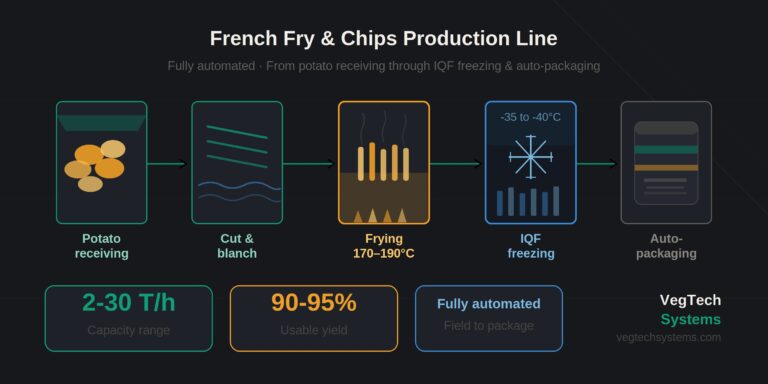
2–30 T/h | Fully Automated from Potato Receiving Through IQF Freezing & Auto-Packaging | 90–95% Yield
The global frozen potato market is growing fast — and U.S. food processors are under increasing pressure to produce more, waste less, and deliver consistent quality at scale. Whether you’re running a high-volume frozen french fry plant or a continuous chips line, your competitive position comes down to one thing: how efficiently your production line converts raw potatoes into market-ready product.
At VegTech Systems, we bring the engineering depth of Bigtem Makine A.Ş. — a specialized food processing equipment manufacturer with over 50 years of experience based in Istanbul, Turkey — directly to the American market. Our fully automated french fry and chips lines run from 2 to 30 tons per hour, are engineered for 90–95% usable yield, and are designed as true turnkey systems: from potato receiving all the way through IQF freezing and automatic packaging.
Here’s a stage-by-stage breakdown of how a well-engineered production line achieves those numbers — and where most processors leave yield, quality, and uptime on the table.
The Complete Production Flow
A fully automated line moves through the following sequence without manual handoffs between stages:
Reception → Size Grading → Washing → Inspection → Warming → Peeling → Cutting → Blanching → Bleaching → Dewatering → Laser Sorting → Drying → Frying → Cooling → IQF Freezing → Automatic Packaging
Each station must be calibrated to feed the next without creating bottlenecks, product damage, or waste. That’s the difference between a collection of machines and an engineered system.
Stage 1: Potato Receiving & Size Grading
Efficiency starts before a single potato is peeled. Raw material quality — variety, dry matter content, sugar level, and size uniformity — sets the ceiling for everything downstream.
Automated size grading at intake immediately routes undersized or irregular potatoes away from the primary line, protecting blade life and preventing yield loss at the cutting stage. Calibrated bin dumpers and infeed conveyors ensure a continuous, gentle flow into the wash stage — eliminating the bruising that quietly erodes yield in under-optimized plants.
Best practice for U.S. processors: High-starch varieties with dry matter ≥ 20% and sugar content ≤ 0.2% deliver the best fry color, texture, and oil absorption. Russet Burbank remains the benchmark for frozen fry production in North America.
Stage 2: Washing & Stone Removal
High-pressure rotary washers and integrated stone traps remove soil, debris, and surface contaminants before any cutting equipment is exposed to the product. This step protects both food safety compliance — HACCP, FDA/USDA standards — and your capital equipment from abrasive damage.
Multi-stage washing with recirculation filtration significantly reduces water consumption, an increasingly important metric for U.S. processors managing utility costs and sustainability reporting.
Stage 3: Peeling
Two primary peeling technologies serve different plant scales and product goals:
Steam peeling — the standard for high-capacity lines — uses pressurized steam to loosen the skin, which is then removed by brush machines. It delivers clean, smooth peeled potatoes with minimal flesh loss, directly driving final yield upward.
Abrasive peeling — well-suited for chips lines and lower-capacity operations — uses rotating abrasive rolls to remove skin through a tumbling action. Simpler, compact, and cost-effective for the right application.
A dry brush machine following steam peeling removes any remaining skin fragments without damaging the potato surface, preserving the geometry needed for consistent cutting downstream.
Yield note: Peeling losses typically account for 15–25% of raw potato weight. Precision steam peeling at the correct pressure and dwell time can push usable yield to the high end of that range — a significant dollar impact at scale.
Stage 4: Cutting — Where Product Quality Is Made or Lost
For frozen french fries, the cutter defines strip geometry: 6×6 mm, 8×8 mm, 10×10 mm, crinkle-cut, wedge. For chips, the slicer determines thickness consistency — directly affecting color uniformity, texture, and oil absorption in the fryer.
VegTech Systems offers Bigtem’s Hydro Cutter, a precision high-pressure cutting system that propels potatoes through a fixed knife assembly via a water stream, producing clean, uniform strips at capacities from 500 kg/h to 5 T/h with minimal breakage. This is the gold standard for industrial french fry lines.
For chips lines, consistent slice thickness — typically 1.2–2.0 mm — is non-negotiable. A variation of even 0.2 mm creates mixed color profiles and inconsistent texture within a single batch, generating rejects and customer complaints.
A longitudinal sorter immediately downstream separates corner cuts and short-length pieces from full-length strips, protecting packaging weight accuracy and consumer quality perception.
Stage 5: Blanching & Bleaching
Blanching is one of the most technically critical stages on the line. Done correctly, it:
- Inactivates enzymes that cause browning and off-flavors
- Gelatinizes surface starch to create the crisp outer layer after frying
- Removes excess surface sugars to control final fry color
- Softens potato tissue for consistent downstream processing
Optimal blanching runs at 65–90°C with precise time control matched to cut geometry and potato variety. A well-calibrated blancher improves post-fry crispness, stabilizes color, and directly extends packaged shelf life — all of which matter when your product is moving through U.S. retail or foodservice distribution channels.
Bigtem blanchers are designed for uniform temperature distribution across the full product bed, with robust screw or belt conveyance built for 24/7 continuous operation.
Bleaching (sulfite treatment) is applied in lines where extended color stability through freezing, storage, and final consumer preparation is required — particularly for export-targeted production.
Stage 6: Dewatering & Drying
Surface moisture is one of the most overlooked efficiency factors on a production line. Excess water entering the fryer:
- Drops oil temperature, reducing throughput and consistency
- Increases oil absorption in the finished product
- Accelerates oil degradation, raising operating costs
Vibrating dewatering decks remove bulk surface water. Purpose-built dryers then reduce surface moisture to target levels before the fryer. Final packaged product moisture content should be below 5% — a key quality and shelf-life specification for U.S. retail and export markets.
Optimized drying is one of the least discussed but highest-ROI improvements available on most existing lines.
Stage 7: Laser Sorting
Modern high-capacity lines integrate laser and optical sorting between the pre-fry and frying stages. These systems detect and eject discolored or defective strips, foreign material, and off-size pieces that escaped upstream sorting — in real time, without slowing throughput.
This is a key contributor to the 90–95% final usable yield benchmark. Only product meeting full visual and dimensional specification enters the fryer, ensuring your packaged output consistently meets the standards U.S. retailers and QSR accounts demand.
Stage 8: Frying — Precision at High Temperature
Frying is the most energy-intensive and quality-defining stage on the line.
Critical parameters:
- Temperature: 170–190°C (lower for pre-fry/partial cook; higher for fully cooked output)
- Dwell time: 40 seconds to 2+ minutes depending on cut geometry and target moisture
- Oil management: Continuous filtration to remove fines, with rapid oil turnover to preserve quality
For french fry lines, continuous conveyor fryers with wire-mesh belts, precise oil heating control, and integrated fine-removal filtration are the standard. Well-designed systems pass the full fryer oil volume through filtration more than 50 times per hour — directly protecting oil quality and extending the shelf life of the finished product.
For chips lines, paddle-arrangement fryers gently tumble slices through the oil bath, ensuring even exposure on both sides without breakage — a critical design consideration given how fragile chips are post-cut.
Energy options — natural gas, steam, thermal fluid, or electric heating — are selected based on plant utility availability, energy cost, and sustainability targets. All Bigtem frying systems are clean-in-place (CIP) capable, minimizing downtime during product changeovers.
Stage 9: Cooling
Rapid post-fry cooling before IQF freezing is a step that processors frequently underinvest in — and pay for in freezer operating costs and product quality losses.
Fries entering an IQF tunnel while still very hot increase compressor load, risk surface ice crystal formation, and can lose texture quality in the finished product. Advanced ambient air-cooling systems remove heat from recently-fried product at rates far exceeding conventional approaches, reducing both freezer maintenance costs and long-term energy consumption.
Stage 10: IQF Freezing — Locking in Quality for Distribution
Individual Quick Freezing (IQF) is the technology that makes frozen french fries and chips viable for national and global distribution. Unlike bulk blast freezing, IQF:
- Freezes each strip or slice individually — no clumping, no block formation
- Drives the product core to -18°C through the critical 0 to -5°C ice crystal formation zone as rapidly as possible
- Preserves texture, color, flavor, and nutritional value with minimal cellular damage
IQF tunnel specifications for high-capacity lines run at evaporation temperatures of -35°C to -40°C, with air-balance systems for uniform freezing across the full belt width and full PLC integration with the central control system.
Properly IQF-frozen product achieves a shelf life of up to 12 months — enabling broad national distribution, export programs, and the extended inventory windows that U.S. retail buyers require.
VegTech Systems’ turnkey lines include IQF freezing integration scaled to your specific capacity, with full commissioning and process calibration support from our Chicago-based engineering team.
Stage 11: Automatic Packaging — Market-Ready, Every Unit
Automated packaging closes the loop between production and shelf. Modern systems on fully automated lines handle:
- Multi-head combination weighers for accurate fill weights across retail pack sizes (500g, 900g, 1 kg, 2.5 kg) and foodservice bulk formats
- Vertical form-fill-seal (VFFS) bag-making for retail or bulk packaging
- Nitrogen flushing options for extended shelf life
- Automated date coding and lot traceability for FDA/USDA compliance
- Case packing and palletizing for direct cold storage transfer
Every VegTech Systems line includes metal detectors and box sealers as standard safety and compliance components — ensuring every unit leaving the line meets U.S. food safety specifications before it reaches your customer.
Chips Lines: Shared Logic, Unique Demands
The core process principles overlap significantly between french fry and chips lines — but chips production has requirements that demand specific engineering choices:
- Slice thickness control is paramount: even minor variation causes non-uniform frying and batch-level color inconsistency
- Gentle product handling throughout: chips are fragile post-fry and require carefully designed conveyor and transfer systems to minimize breakage losses
- Seasoning application — drum, tumbler, or spray — is integrated post-fry and before packaging, with precise dosing for flavor consistency
- Frying parameters differ: shorter dwell times, lower oil volumes per kg, and a higher surface-area-to-mass ratio demand tighter temperature control than fry lines
Bigtem’s Potato Chips Production Line is engineered specifically around these requirements, with product-specific conveying, cutting, frying, and inspection configurations available at capacities suited to U.S. snack and private-label processors.
Where the 90–95% Yield Actually Comes From
World-class potato processing yield isn’t the result of any single machine — it’s the product of system-level engineering, proper calibration, and continuous process monitoring across every stage.
| Production Stage | Yield & Efficiency Impact |
|---|---|
| Raw material QC & grading | 3–5% swing in usable raw mass |
| Precision steam peeling | 5–8% advantage over abrasive peeling |
| Hydro-cutting accuracy | 2–4% reduction in breakage and short-cuts |
| Blanching calibration | Controls color reject rate and shelf life |
| Laser sorting integration | Eliminates non-spec product at the source |
| IQF freezing speed | Protects texture; eliminates defrost losses |
| Auto-packaging weight accuracy | Label compliance; reduces product give-away |
When each stage is engineered and calibrated as part of an integrated system — not assembled from mismatched standalone equipment — the cumulative yield improvement is the gap between 80% and 93%+.
That difference represents millions of dollars in raw material cost at any meaningful production scale.
VegTech Systems: Engineering-Driven Solutions for U.S. Processors
As the U.S. representative for Bigtem Makine A.Ş., VegTech Systems delivers fully engineered, turnkey french fry and chips production lines to American food processors — backed by local engineering support from our Chicago, IL headquarters.
What that means for your project:
- Turnkey scope: process line design, equipment manufacturing, U.S. installation, commissioning, and operator training — one point of contact for the full project
- Scalable capacity: lines from 2 T/h to 30 T/h, with modular architecture designed for future expansion as your volume grows
- Proven equipment: Bigtem’s 50+ years of food processing engineering, deployed in plants across multiple countries and operating environments
- U.S. market alignment: equipment configured to meet FDA/USDA standards, HACCP compliance requirements, and the expectations of U.S. retail and QSR buyers
- Dual-product capability: both Frozen French Fries and Potato Chips lines available, enabling processors to diversify product mix on a single capital investment
Ready to Design Your Production Line?
Whether you’re building a new greenfield plant, expanding an existing facility, or replacing aging equipment to compete at the quality and efficiency levels today’s U.S. market demands — the conversation starts with your capacity target, product mix, and yield requirements.
VegTech Systems provides fast engineering response for U.S. processors. Contact our team to request equipment specifications, discuss your production goals, or start a full line design consultation.
 (414) 378-9956
  vegtechsystems.com/contact