
Advanced Peeling Systems: The Key to Better Yield and Quality
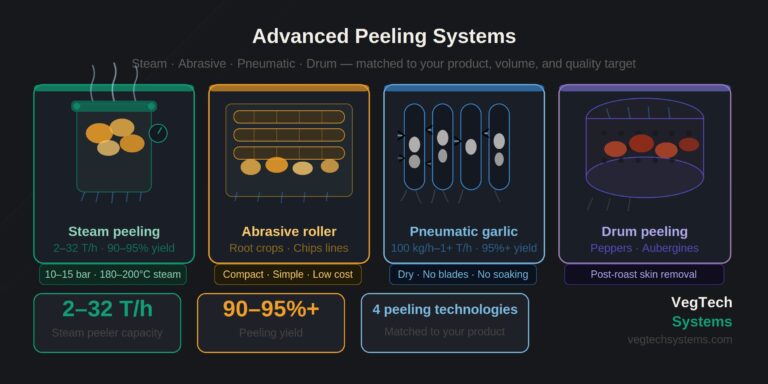
Steam · Abrasive · Pneumatic · Drum | 2–32 T/h | 90–95%+ Peeling Yield | Engineered for U.S. Processors
In industrial food processing, peeling is rarely the step that gets the attention — but it is almost always the step where yield and quality are won or lost. Before your product reaches a cutter, a blancher, or a fryer, the peeling stage has already determined how much usable material you have to work with, what the surface looks like, and whether downstream processing will be consistent or problematic.
For processors handling potatoes, carrots, beets, garlic, tomatoes, peppers, and other produce at scale, the choice of peeling technology — and the engineering of that system — directly translates into dollars. A 5% improvement in peeling yield at 10 T/h means hundreds of thousands of dollars in raw material value recovered per year. At 20 T/h, it’s transformative.
At VegTech Systems, we supply and integrate four distinct Bigtem-engineered peeling technologies for the U.S. market, each matched to specific products, production volumes, and quality targets. This guide explains how each system works, where it excels, and how to select the right approach for your operation.
Why the Peeling Stage Defines Everything Downstream
Most processors focus their optimization attention on cutting, frying, and packaging — the stages that are most visible and easiest to measure. But the peeling stage sets the conditions that all of those downstream processes depend on.
Surface quality affects how a product cuts, how it blanches, how it fries, and how it freezes. A rough, uneven peel leaves surface irregularities that create inconsistent oil absorption in the fryer, uneven blanching penetration, and visual defects in the finished product.
Yield is determined primarily at the peeling stage. Abrasive methods that remove too much flesh, or steam cycles that are not calibrated to product size and variety, create losses that no downstream process can recover. The edible material removed at the peeler is gone permanently — it becomes waste, not product.
Throughput consistency depends on peeler design and integration. A peeling system that creates bottlenecks, requires frequent manual intervention, or delivers uneven product to the next stage undermines the performance of the entire line.
Getting peeling right — with the right technology, properly calibrated, and properly integrated — is the single highest-leverage investment in any vegetable or root crop processing line.
The Four Peeling Technologies VegTech Systems Offers
1. Steam Peeling — Maximum Yield for Root Crops and Fruit
Steam peeling is the gold standard for high-capacity potato, carrot, beet, tomato, and apple processing. Rather than relying on friction or chemicals, a steam peeler uses high-temperature, high-pressure steam to rapidly loosen the skin from the flesh in a matter of seconds — after which a brief brushing or water rinse removes the detached skin cleanly.
How it works: Product is loaded into a sealed pressure vessel. Steam at 10–15 bar and 180–200°C is introduced for a precisely controlled dwell time. The rapid pressure differential between the steam-saturated skin and the cooler flesh below causes the skin to blister and separate. When the vessel depressurizes, loosened skins are flushed away by a water rinse and brush pass. The result is a clean, smooth-surfaced product with minimal flesh loss.
Bigtem steam peelers, supplied by VegTech Systems, handle capacities from 2 to 32 T/h, with the 32 T/h model consuming 700 kg/h of steam at 10–15 bar, 4 kW of power, and 1.8 m³/h of water at 4 bar. Yield consistently reaches 90–95% — recovering significantly more usable product than abrasive methods.
Why steam peeling outperforms alternatives on yield:
Abrasive peeling physically grinds away the skin using friction. This is an imprecise process — it removes some flesh along with the skin, and the loss accelerates with irregular potato shapes, deep eyes, and size variation in the incoming raw material. Peel losses with abrasive methods typically run 10–20% of raw weight. Steam peeling, by contrast, removes only the thin skin layer itself, keeping losses to 8–10% or less under well-calibrated conditions.
For a processor running 10 T/h of potatoes, the difference between 10% and 18% peeling loss is 800 kg/h of additional usable product — product that was purchased, received, washed, and now either becomes finished goods or waste. At scale, that arithmetic drives the decision toward steam.
Ideal applications:
- Frozen french fry and chips lines (smooth surface required for clean cutting geometry)
- Ready-to-eat and fresh-cut potato and carrot products for retail
- Tomato and apple processing for puree, sauce, and juice lines
- Industrial root crop processing for food service and ingredient supply
Calibration is everything: Steam pressure, temperature, and dwell time must be tuned to the specific product variety, size distribution, and skin thickness. Potatoes typically require 6–8 bar for 6–8 seconds. Carrots, with thicker skins, may require higher pressures or slightly longer exposure. Beets and sweet potatoes need precise timing to prevent flesh damage. VegTech Systems’ engineering team provides this calibration support as part of line commissioning.
2. Abrasive Roller Peeling — Versatile, Compact, and Cost-Effective
The VegTech Abrasive Roller Peeler, engineered by Bigtem Makine, uses a series of abrasive-coated rotating rolls to scrub away the skin of root vegetables and firm produce through a combination of direct abrasion and tumbling-induced surface contact. It is a simpler, more compact technology than steam peeling — and the right choice for a significant range of applications.
How it works: Raw produce is fed into a bed of rotating abrasive rolls. The abrasive surface removes skin both directly (by rubbing against it) and indirectly (by generating a tumbling motion that causes produce to rub against adjacent pieces). Water sprays continuously wash away loosened skin and debris throughout the process.
Where abrasive peeling makes sense:
- Potato chips lines, where a slightly textured surface post-peel is acceptable and compact equipment footprint is valued
- Lower-capacity operations where steam peeler capital cost is not justified by volume
- Secondary product lines running alongside a primary steam-peeled line, for products where cosmetic surface quality is less critical (soups, sauces, industrial ingredient supply)
- Carrots, beets, celery root, and similar firm root vegetables where the abrasive method delivers acceptable yield at lower investment
Multiple machine sizes are available for both medium and large-scale production, with all-stainless food-grade construction designed for continuous operation and easy sanitation.
The honest trade-off: Abrasive peeling is reliable, low-maintenance, and well-understood — but it consistently produces higher peel loss than steam, particularly with irregular or non-uniform raw material. Processors who start with abrasive peeling and scale up typically transition to steam as volume grows and the yield economics become compelling.
3. Pneumatic Air-Blast Peeling — Damage-Free Garlic Processing
Garlic is a fundamentally different peeling challenge from root crops. The skin is paper-thin, tightly adhered in places, and the clove beneath is delicate — any method that uses blades, water soaking, or aggressive abrasion risks damage that reduces shelf life, introduces moisture-related spoilage risk, and degrades the appearance of the finished product.
The VegTech Garlic Peeler, built by Bigtem Makine, uses pneumatic airflow technology — high-pressure, high-volume air blasts — to remove garlic skins without any of those risks. The process is dry, damage-free, and highly efficient.
How it works: After globe separation and conditioning in a tumbling drum (which crisps the skin for easier removal), individual cloves are fed into peeling tubes where repeated high-pressure air blasts rub and dislodge the skin. A vortex washer removes any inner skin residue, and vibrating decks with air knives eliminate surface moisture before the clean cloves proceed to inspection, grading, and packaging.
Performance specifications:
- Capacity: 100 kg/h to 1,000+ kg/h
- Peeling efficiency: over 95%
- Process: fully dry — no water soaking, no chemicals, no blades
- Output: whole, intact cloves ready for fresh-pack, freezing, or further processing
- Packaging integration: size grading, nitrogen-flushed multilayer bags, cold storage transfer
Why dry peeling matters for food safety: Water soaking — a common alternative method — introduces microbial risk by creating conditions favorable to bacterial growth. It also degrades the clove surface and shortens shelf life. The pneumatic method produces a clean, dry clove surface that supports longer shelf life without compromising the natural flavor and texture that buyers expect.
Applications across the garlic supply chain:
- Retail fresh-peeled garlic packs (1 kg–2.5 kg bags, nitrogen-flushed)
- Frozen peeled garlic cloves for food service
- Canned and pickled garlic for industrial and consumer markets
- Minced and chopped garlic ingredient supply for food manufacturers
4. Drum Peeling — Specialized Handling for Roasted Peppers and Aubergines
Some products require a peeling solution that conventional technologies cannot address. Roasted peppers and aubergines — where the skin has been charred and blistered through high-heat roasting — need a method that removes the loosened skin without damaging the soft, roasted flesh beneath.
Bigtem’s Drum Peeler fills this role. Product travels through a declined rotating concave perforated drum, where a combination of rubbing/scratching action and pressurized water wash removes the roasted skin continuously and gently. The inclined rotation ensures product movement through the drum without manual handling, and the perforated drum design allows loosened skin and water to drain away continuously during the process.
This system integrates directly into roasted pepper and aubergine processing lines for ajvar, sauces, and ready-to-eat products — a segment where VegTech Systems offers full line solutions through Bigtem’s engineering portfolio.
Choosing the Right Peeling Technology: A Decision Framework
The right peeling system depends on four variables that interact differently for every processor:
1. Product type and skin characteristics Root vegetables with thin, uniform skins (potatoes, carrots) respond best to steam peeling at scale. Firm produce with tougher skins tolerates abrasive peeling well. Delicate produce (garlic, tomatoes) requires technology-specific solutions.
2. Production volume and throughput target Steam peeling capital cost is justified at higher throughputs where yield gains generate meaningful return. At lower volumes, abrasive peeling offers a practical and cost-effective entry point. For garlic, pneumatic systems scale from 100 kg/h to over 1 T/h to match facility size.
3. Surface quality requirements for downstream processing Frozen french fry and premium fresh-cut lines require the smooth, consistent surface that steam peeling delivers. Products destined for soups, sauces, or industrial ingredient use have more tolerance for surface texture variation.
4. Peel loss tolerance and raw material cost The higher the raw material cost, the stronger the economic case for steam peeling. At $0.20–$0.40/kg for raw potatoes or carrots, a 5–8% improvement in peel yield at 10 T/h generates $10,000–$32,000 per week in recovered product value — a compelling ROI calculation for high-volume operations.
| Technology | Best Products | Capacity | Yield | Key Advantage |
|---|---|---|---|---|
| Steam peeler | Potato, carrot, beet, tomato, apple | 2–32 T/h | 90–95%+ | Maximum yield, smooth surface |
| Abrasive roller | Root crops, potato chips lines | Medium–large scale | 80–90% | Low cost, compact, simple |
| Pneumatic air-blast | Garlic | 100 kg/h–1+ T/h | 95%+ | Damage-free, dry, hygienic |
| Drum peeler | Roasted peppers, aubergine | Custom | Product-specific | Handles post-roast skin removal |
Integration: Peeling as Part of a Complete Processing Line
A peeling system does not operate in isolation. Its output feeds directly into your washing, inspection, cutting, and further processing stages — and the quality and consistency of that output determines how every downstream stage performs.
At VegTech Systems, we engineer peeling systems as integrated components of complete turnkey lines, not as standalone machines. That means:
- Infeed alignment: Sizing and grading equipment upstream of the peeler ensures consistent raw material is presented to the peeling system, improving uniformity and reducing overpeeling of smaller pieces
- Post-peel inspection conveyors: Manual or optically assisted inspection stations immediately downstream catch any residual skin patches or defective product before it enters cutting or further processing
- Water and steam management: Integrated water recirculation, condensate recovery, and steam supply systems are designed as part of the line specification — not afterthoughts
- CIP (clean-in-place) design: All Bigtem peeling equipment is designed for hygienic operation with streamlined CIP protocols, supporting HACCP compliance and minimizing sanitation-related downtime
The Business Case: What Better Peeling Is Actually Worth
Here is a simple illustration of the yield economics at two production scales:
Scenario A — 5 T/h potato line, abrasive vs. steam peeling:
- Abrasive: 15% peel loss = 750 kg/h waste
- Steam: 9% peel loss = 450 kg/h waste
- Recovered product: 300 kg/h × $0.35/kg = $105/h
- At 16 operating hours/day, 250 days/year: $420,000/year in additional recoverable product value
Scenario B — 15 T/h line:
- The same yield differential at three times the throughput = $1.26M/year in raw material recovery
These figures do not account for the downstream value-add applied to that recovered product through cutting, frying, freezing, and packaging. The actual revenue impact is substantially higher.
Peeling system selection is not a capital equipment decision in isolation — it is a raw material economics decision with a multi-year return horizon.
VegTech Systems: Engineering-Matched Peeling Solutions for U.S. Processors
As the U.S. representative for Bigtem Makine A.Ş., VegTech Systems brings 50+ years of specialized food processing engineering to American produce and vegetable processors — backed by local support from our Chicago, IL operations.
We don’t sell peeling machines. We design and deliver peeling systems — properly sized, calibrated to your specific raw material and throughput target, and integrated into the broader processing line to maximize yield and quality from receiving to packaging.
Whether you are building a new line, replacing aging equipment, or looking to improve yield on an existing operation, the conversation starts with your product, your volume, and your quality targets.
Contact VegTech Systems for a peeling system consultation:
 (414) 378-9956
  vegtechsystems.com/contact