
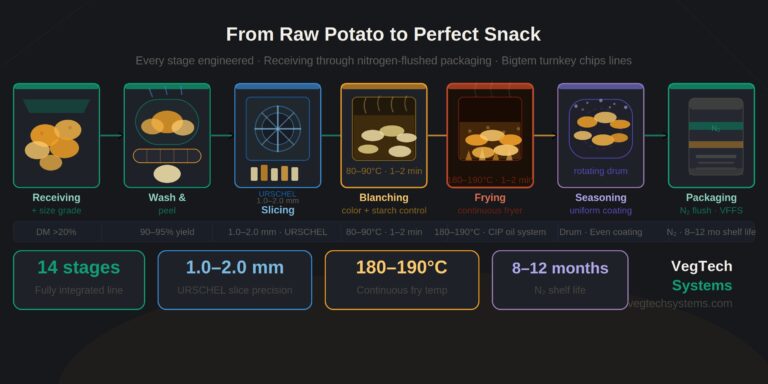
From Raw Potato to Perfect Snack: A Complete Processing Guide
Every Stage Engineered | Receiving Through Nitrogen-Flushed Packaging | Bigtem Turnkey Chips Lines for U.S. Processors
The U.S. snack food market generates over $30 billion in annual retail sales, and potato chips remain its single largest category. Behind every bag on that shelf is a processing line that made hundreds of decisions — about raw material selection, slice geometry, blanching parameters, fry temperature, de-oiling, seasoning application, and packaging atmosphere — and got all of them right, consistently, at production speed.
That is not a simple operation. It is a precisely engineered sequence where every stage feeds the next, where a mistake at the slicer creates a quality problem at the fryer, and where a poorly calibrated blancher produces color defects that no seasoning can hide. The difference between a snack that sells and one that sits on the shelf is often invisible to the consumer — it was decided upstream, in the processing plant.
At VegTech Systems, we design and supply complete, turnkey potato chips processing lines for U.S. producers, built on Bigtem Makine’s 50+ years of specialized food processing engineering. This guide walks every stage of the process — from raw potato receiving to sealed, nitrogen-flushed retail bag — and explains exactly what it takes to get each one right.
Stage 1: Raw Material Selection & Receiving
The processing line begins not at the plant gate but at the field. The variety of potato you process sets the ceiling for everything your line can achieve.
What to look for in raw material:
- Dry matter content: above 20% — higher dry matter means lower moisture, less water to drive off in frying, lower oil uptake in the finished chip, and a crisper final texture
- Reducing sugar content: below 1% — reducing sugars react with amino acids at frying temperatures to produce the dark pigmentation (Maillard browning) that creates over-colored, bitter-tasting chips. This is the number one raw material variable driving color rejection
- Size uniformity — inconsistent potato size creates peeling loss variation, slice geometry problems, and uneven frying across the production run
- Shallow eyes and smooth skin — deep eyes trap peel and require either more aggressive peeling (higher yield loss) or more labor in inspection
At the plant, receiving hoppers and bin dumpers — sized to your throughput — feed the line continuously. Bigtem’s material handling equipment is configured for your specific raw material logistics, whether that is bulk bin receiving, bag dumping, or direct conveyor infeed from field transport.
Stage 2: Size Grading
Before any processing begins, incoming potatoes are graded by size. This is not a cosmetic step — it is a yield and efficiency step.
Undersized potatoes represent a disproportionately high peel loss percentage (a small potato has nearly the same peel thickness as a large one, but far less interior flesh). Oversized potatoes can jam cutting equipment or produce slices that are too long for the fryer’s belt dimensions.
Size grading screens separate incoming raw material into accepted and rejected streams before any water, energy, or machine time is spent on product that cannot meet your specification. Rejected undersized stock can be rerouted for other processing applications — mashed potato, starch production, or other value streams — rather than creating waste.
Stage 3: Washing & Stone Removal
Potato washing has two functions: removing soil and surface contamination, and protecting downstream equipmentfrom stones and debris that can destroy slicing blades, jam conveyors, and create metal contamination risks.
Drum washers with integrated stone trappers are standard at this stage. High-pressure spray systems combined with rotating drum action remove soil, plant material, and surface bacteria while stone separation systems use density and flow dynamics to remove rocks and heavy debris before they reach any precision equipment.
This is also where preliminary inspection occurs — visual defects, green patches, and severely damaged material is removed before peeling.
Water management at this stage matters for operating cost. Bigtem washing systems are designed with recirculation capabilities that reduce water consumption significantly compared to single-pass wash systems — relevant to U.S. processors managing water costs and sustainability commitments.
Stage 4: Peeling
For potato chips, the peeling stage must balance two competing objectives: removing the skin completely (to deliver the clean, smooth slice surface that produces consistent chips) while minimizing flesh loss (yield directly translates to cost of goods).
Abrasive roller peeling is the standard technology for chips lines — it is compact, reliable, and cost-effective. Rotating abrasive rolls remove skin through a combination of direct friction and tumbling-induced surface contact, with water sprays washing away loosened peel continuously. The abrasive peeler excels precisely in its simplicity and minimum footprint — characteristics that matter in chips lines where compact equipment configuration is often a facility constraint.
The VegTech Abrasive Roller Peeler, built by Bigtem Makine, is configured for root vegetables including potatoes — designed for durability, hygienic construction, and integration into continuous production flow.
For higher-capacity operations where yield improvement justifies the investment, Bigtem steam peelers (2–32 T/h, 10–15 bar, 180–200°C steam) deliver 90–95% peel yield by loosening skin without removing flesh — producing a smoother surface that performs more consistently through the slicing stage.
Post-peel inspection on a slow-moving conveyor gives operators the access they need to remove eyes, green patches, and peel remnants before the potato reaches the slicer.
Stage 5: Slicing — The Most Critical Quality Variable
Slice thickness is the single most important parameter in potato chip production. Every downstream stage — blanching, dewatering, frying, de-oiling — is calibrated to a specific slice thickness. When that thickness varies, nothing downstream can compensate.
The target range is 1.0–2.0 mm. Below 1.0 mm, chips are too fragile — they break during handling, produce excessive fines, and over-color rapidly in the fryer. Above 2.0 mm, chips are undercooked in the center, greasy, and soft. A variation of 0.2 mm across a single batch creates a bimodal distribution of chip quality in the same package.
Bigtem’s lines integrate URSCHEL cutting equipment — the industry benchmark for precision, blade life, and throughput consistency in high-volume potato and vegetable processing. URSCHEL slicers deliver the thickness uniformity that consistent chip quality demands.
Chip style options at the slicer:
- Flat cut (standard round chip) — the baseline format for most retail applications
- Crinkle cut — wavy blade profile creates ridged chips with more surface area, higher seasoning adhesion, and a distinctive texture consumers associate with premium or kettle-style products
- Kettle-style — batch processing at lower continuous throughput, producing the irregular, folded texture that commands a premium in the U.S. natural and better-for-you snack segment
Stage 6: Rinsing — Starch Removal Before the Fryer
Immediately after slicing, potato slices are rinsed in cold water to remove free surface starch. This step is often underestimated in its importance.
Surface starch on potato slices does three things in the fryer that you do not want: it causes slices to stick together (cluster formation breaks chips and creates rejects), it introduces fines that degrade oil quality over time, and it creates uneven browning on the chip surface.
Rinsing systems on Bigtem chips lines are designed to separate slices, eliminate clusters, and feed a monolayer of slices across the full width of the fryer belt — ensuring every slice gets uniform oil exposure and consistent dwell time. Slices that enter the fryer overlapping or clustered exit it with quality problems that packaging inspection will have to reject.
Cold water immersion during rinsing also prevents oxidative browning between slicing and blanching — protecting chip color before the blanching stage locks it in.
Stage 7: Blanching — Color, Texture, and Oil Uptake Control
Blanching is one of the highest-leverage stages on a potato chips line. Done well, it locks in target color, controls final chip texture, and significantly reduces oil content in the finished product. Done poorly, it produces chips that are too dark, too light, greasy, or that blister visibly in the package.
How blanching works and why it matters:
Hot water blanching at 80–90°C for 1–2 minutes achieves several simultaneous effects:
- Enzyme inactivation — polyphenol oxidase and peroxidase enzymes responsible for enzymatic browning are deactivated, locking in the pale golden color of the potato flesh
- Sugar reduction — blanching leaches out a portion of the reducing sugars that drive Maillard browning in the fryer, allowing processors to use raw material with slightly higher sugar content without sacrificing chip color — extending the viable raw material supply window
- Starch gelatinization — partial gelatinization of surface starch creates a thin, set layer that regulates oil penetration during frying. This is the primary mechanism by which blanching controls final oil content in the finished chip
- Tissue softening — controlled blanching softens the potato cell structure slightly, improving the crispiness response during frying and reducing the tendency to form hard, under-processed centers in thicker slices
Bigtem blanchers are engineered for precise temperature control and uniform product residence time — the two variables that determine whether blanching delivers consistent results batch after batch, shift after shift.
Stage 8: Dewatering — Surface Moisture Before the Fryer
Surface moisture entering the fryer is a direct operating cost problem. Water hitting hot oil causes:
- Temperature drop — reducing effective throughput as the fryer works to recover set temperature
- Oil spattering — a safety issue and a source of oil mist that loads extraction systems
- Extended frying time — driving up energy consumption per kilogram of product
- Oil degradation — water accelerates hydrolysis of frying oil, shortening oil life and increasing oil cost
Vibrating dewatering decks — a Bigtem core equipment category — remove bulk surface water from blanched slices before they enter the fryer. High-frequency vibration combined with airflow drives water off the slice surface efficiently, reducing moisture load on the fryer and improving both oil life and chip quality.
This stage is simple in concept and often overlooked in equipment specification — but processors who underinvest here pay for it continuously in fryer operating costs.
Stage 9: Frying — Where the Chip Becomes a Chip
The frying stage is the highest-energy, highest-visibility, and most technically demanding stage on a chips line. Every quality attribute the consumer experiences — color, crunch, texture, flavor — is substantially determined here.
Key parameters for potato chips:
- Oil temperature: 180–190°C
- Frying time: 1–2 minutes (dependent on slice thickness, moisture content, and target final moisture)
- Target final moisture: below 2% for maximum crunch and optimal shelf life
- Oil turnover rate — how quickly the full fryer volume is replaced by fresh oil — directly determines oil quality and chip flavor consistency over extended production runs
Continuous fryers are standard for industrial chips lines. Product enters the fryer in a monolayer, is conveyed through the oil bath at a controlled speed that determines dwell time, and exits into the de-oiling system. The fryer belt is designed to allow full oil submersion while maintaining product separation — no clustering, no stacking, uniform heat exposure across every slice.
Oil management is a major operational cost center. Bigtem fryer systems include continuous oil filtration that removes fines from the oil during production — protecting oil quality, extending oil life, and preventing fines from burning and imparting off-flavors to the product. Clean-in-place (CIP) capability minimizes sanitation downtime between production runs.
Energy source options — natural gas, thermal fluid, electric, or steam — are selected during line specification based on facility utility availability, energy cost at the plant location, and sustainability targets.
Stage 10: De-Oiling
Freshly fried chips carry surface oil that must be removed before seasoning and packaging. Excess surface oil at the seasoning stage causes seasoning clumping and poor distribution. In the package, it shortens shelf life and creates an unacceptably greasy mouthfeel.
Vibrating de-oiling decks — another core Bigtem equipment category — use high-frequency vibration combined with air blowing to strip surface oil from chips immediately post-fry. This step also begins the cooling process, since reducing surface oil film simultaneously removes a layer of thermal mass.
For processors targeting the growing reduced-oil snack segment, more intensive de-oiling systems can be integrated to consistently achieve the oil content specifications that “light” and “reduced fat” label claims require.
Stage 11: Cooling
Chips exiting the fryer and de-oiler at 160–180°C must be cooled to near-ambient temperature before seasoning and packaging. Seasoning applied to hot chips melts and clumps rather than coating evenly. Chips sealed into packages while still warm create internal condensation that accelerates staling and generates packaging integrity failures.
Cooling conveyors with controlled airflow bring chips to target temperature without over-cooling, which can introduce condensation from ambient humidity. The cooling zone also provides a final opportunity for visual inspection before seasoning — experienced line operators use this stage to identify color or texture anomalies that upstream adjustments can address.
Stage 12: Seasoning — Creating the Flavor That Drives Repurchase
The seasoning stage is where a potato chip becomes a product — where commodity processing converts to brand differentiation. Getting it right at industrial scale requires engineering, not just flavor science.
Two primary seasoning approaches:
Rotating drum seasoning — the industry standard for most applications. Chips tumble through a rotating stainless steel drum as seasoning is applied via spray nozzles or powder dispensers. The tumbling action ensures full surface contact and even distribution. Drum speed, residence time, and seasoning application rate are all adjustable to match the target seasoning percentage and the specific coating characteristics of each flavor.
Octagonal drum seasoning — a variant that uses an octagonal cross-section drum to create a different tumbling pattern, often preferred for more fragile chip styles where a round drum’s continuous rolling action causes excessive breakage.
What consistent seasoning actually requires:
- Precise and stable chip feed rate into the drum (irregular infeed creates over/under-seasoned portions)
- Controlled seasoning application — flow rate, particle size distribution, and moisture content of the seasoning blend all affect coating uniformity
- Temperature control — chips must be at the right temperature for seasoning adhesion. Too hot and seasoning melts; too cold and adhesion drops
- Regular calibration — blade wear, pump performance, and drum condition all drift over time and must be monitored
Stage 13: Metal Detection & Quality Control
Every unit that leaves your facility carries your brand. Metal detection is non-negotiable — it protects the consumer, protects your brand, and is a prerequisite for retail and food service supply contracts in the U.S. market.
Bigtem chips lines include inline metal detectors positioned before packaging — the final protection point for the finished product. Detection sensitivity is calibrated to catch ferrous, non-ferrous, and stainless steel contamination within the detection limits required by U.S. retail buyers (typically Fe ≥ 1.5mm, non-Fe ≥ 2.0mm, SS ≥ 2.5mm for retail supply).
Visual inspection throughout the line — at the post-peel conveyor, post-fry cooling zone, and post-seasoning — catches color, texture, and size defects that automated systems cannot. Well-designed inspection conveyor access and lighting are engineering decisions that directly determine how effectively your QC team can do their job.
Stage 14: Packaging — Protecting Everything You Built
The last stage of a chips line does more than put product in a bag. It determines shelf life, prevents breakage in distribution, and communicates your brand to the consumer. All of that must happen at line speed, with consistent weight accuracy and hermetic seal integrity on every unit.
Nitrogen flushing is standard on retail potato chips packaging. Nitrogen displaces oxygen inside the package, preventing oxidative rancidity of the chip oil and dramatically extending shelf life — typically to 8–12 months for a properly packaged chip versus 2–4 weeks without gas flushing. It also provides the cushioning effect that protects fragile chips during shipping and retail handling.
Vertical form-fill-seal (VFFS) packaging machines form the bag from roll stock, fill it with the target weight of chips via a multi-head combination weigher, flush with nitrogen, and hermetically seal — all in a single continuous operation at rates suited to your line throughput.
Weight accuracy is a legal compliance issue as well as a cost issue. Multi-head combination weighers achieve the ±1–2% weight accuracy that keeps you compliant with net content labeling requirements while minimizing product give-away — every gram above the stated weight that goes into a bag is margin that goes into the landfill.
The Complete Line: How It Comes Together
The power of a Bigtem turnkey chips line — as supplied by VegTech Systems to U.S. processors — is not in any individual machine. It is in the engineering integration that connects them:
| Stage | Equipment | Key Parameter |
|---|---|---|
| Receiving | Bin dumpers, infeed conveyors | Throughput match to line speed |
| Size grading | Grading screens | Undersize/oversize diversion |
| Washing | Drum washer + stone trap | Soil and debris removal |
| Peeling | Abrasive roller or steam peeler | Peel yield 90–95% |
| Slicing | URSCHEL slicer | Thickness: 1.0–2.0 mm |
| Rinsing | Starch wash + monolayer feeder | Slice separation, starch removal |
| Blanching | Temperature-controlled blancher | 80–90°C, 1–2 min |
| Dewatering | Vibrating deck | Surface moisture removal |
| Frying | Continuous fryer + oil filtration | 180–190°C, 1–2 min |
| De-oiling | Vibrating deck + air blowing | Oil content reduction |
| Cooling | Air cooling conveyor | To ambient before seasoning |
| Seasoning | Rotating drum | Uniform coating, target % |
| Inspection | Metal detector + visual conveyors | Retail-spec detection sensitivity |
| Packaging | VFFS + multi-head weigher + N₂ flush | ±1–2% weight, 8–12 month shelf life |
Every connection between these stages — conveyors, elevators, transfer points, buffer zones — is designed as part of the system, not added as an afterthought. Bigtem’s engineering philosophy is that a chips line is a single integrated machine, not a sequence of separate purchases.
VegTech Systems: Your Complete Chips Line Partner in the U.S.
Designing and building a potato chips line is a major capital commitment. Getting it right the first time — in terms of throughput capacity, product quality, yield performance, and integration with your facility — requires a partner with deep process knowledge, not just an equipment supplier.
As the U.S. representative for Bigtem Makine A.Ş., VegTech Systems brings 50+ years of specialized food processing engineering to American chips producers, backed by local engineering support from our Chicago, IL operations. We handle the full project scope: line design, equipment specification, U.S. installation, commissioning, operator training, and ongoing support.
Whether you are building your first chips line, scaling an existing operation, or upgrading aging equipment to compete on quality and efficiency with the brands currently holding your target shelf position — we start with your product, your throughput target, and your facility, and engineer from there.
Contact VegTech Systems for a chips line consultation:
📞 (414) 378-9956 🌐 vegtechsystems.com/contact